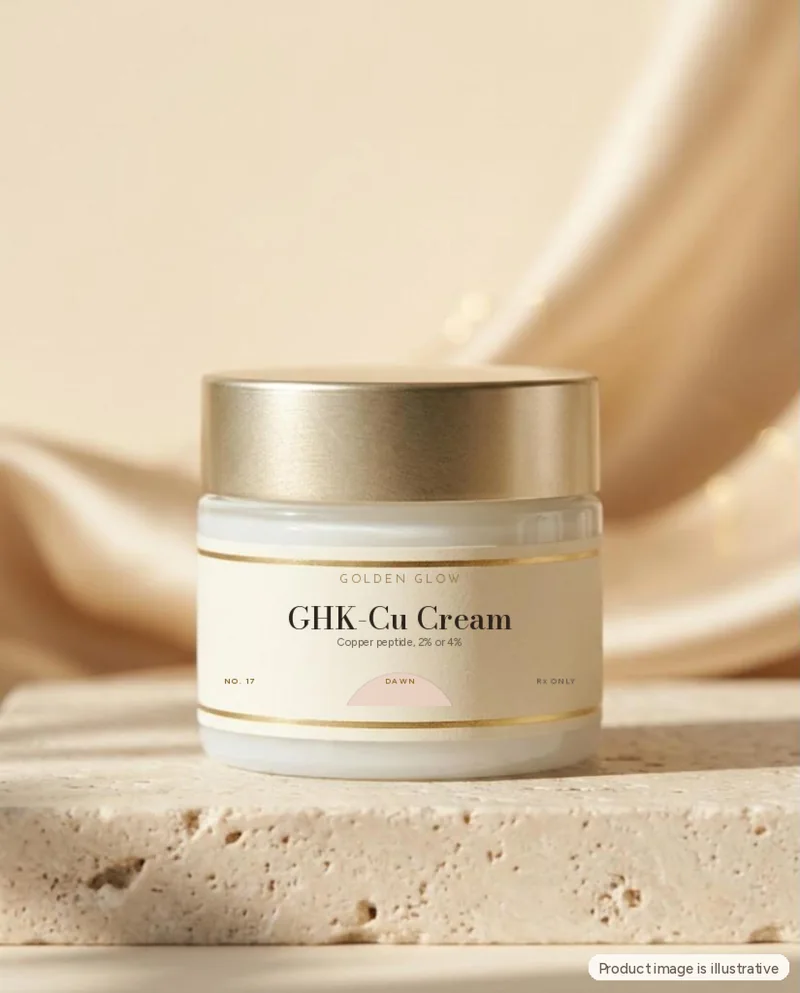
Product image is illustrative. Your medication and packaging may look different.
No. 17 · Hair and skin
GHK-Cu Copper Peptide Cream
Copper peptide 2% or 4%
GHK-Cu cream is a prescription copper peptide cream, made by a licensed US pharmacy, that a licensed provider may prescribe for skin that looks tired, thin or less firm. Lab research shows GHK-Cu supports collagen, and small human studies of topical use reported changes in firmness and fine lines, though many were small or industry funded.
Studied for skin and collagen.
| Option | Monthly | Quarterly, 3 months | Start |
|---|---|---|---|
| GHK-Cu 2% cream | $235 | $530about $177 a month | Start |
| GHK-Cu 4% creamAt your licensed provider's discretion | $320 | $790about $263 a month | Start |
Prices include the online visit, licensed provider review, medication and shipping. Quarterly plans ship three months at a time. Cancel or pause anytime. Available online in Detroit, Metro Detroit and across Michigan, and in other states where our providers are licensed.
Online visits for Detroit, Metro Detroit and Michigan. Questions first? Email support@hoolongevity.com or call (586) 321-3377.
Who it's for
- Women who want a gentle, evidence-informed addition to a skincare routine
- People who find retinoids hard to tolerate
- Skin that has changed with age, sun or the menopause transition
Not for
- Anyone with a known copper allergy or allergy to an ingredient
- Broken, infected or freshly treated skin unless your provider says otherwise
- Pregnancy or breastfeeding, where there is not enough data
Your licensed provider reviews your full history and decides what is appropriate.
How it works
Answer a short skin and health questionnaire online
A licensed provider reviews it and chooses 2% or 4% if appropriate
Your cream ships from a licensed US pharmacy
Apply as directed on the label, usually to clean skin before moisturizer, with daily sunscreen
What's included
- Online visit and licensed provider review
- Compounded GHK-Cu cream, 30 g per month
- Shipping in discreet packaging
- Messaging with your care team
Important safety information
- Stop using it and contact your care team if you develop redness, stinging, itching, swelling or a rash.
- Patch test on a small area first if your skin is reactive.
- For external use only. Avoid eyes and mucous membranes.
- Compounded medications are prepared by a licensed US pharmacy for an individual patient. They are not FDA-approved, and the FDA does not verify their safety, effectiveness or quality before they are dispensed.
Prescription only. A licensed provider reviews your health history in an online visit and decides whether this program is appropriate for you. Tell your provider about every medication, supplement, allergy and condition, and whether you are pregnant, trying to conceive or breastfeeding. If you have a severe reaction, trouble breathing, chest pain or swelling of the face or throat, call 911.
Full details: safety information. Updated November 3, 2026.
Questions, answered
Straight answers about GHK-Cu Copper Peptide Cream.
What is GHK-Cu and what does it actually do for your skin?
GHK-Cu is a small copper-binding peptide found naturally in the body that has been used in skincare for decades. Lab studies show it supports collagen production and calms inflammation, and small human studies of topical use report improvements in firmness and fine lines, though many were small or industry-funded. Results vary, so a licensed provider can tell you whether it fits your skin goals.
Is a prescription copper peptide cream any different from the copper peptide serums at Sephora?
Yes. A prescription GHK-Cu cream is prepared by a licensed US pharmacy from a prescription written by a licensed provider, while store serums are cosmetics sold over the counter. Compounded products are not FDA-approved, and the FDA does not verify their safety, effectiveness or quality before they are dispensed, so the real differences are how the product is made, who oversees it, and the provider review of your skin history. Strength and formula vary across copper peptide products, so ask your provider what yours contains.
Do copper peptides cause purging or breakouts?
GHK-Cu is not known to cause purging the way exfoliating acids or retinoids can, but any new product can cause irritation or breakouts in some people. Redness, stinging, itching or a rash may signal sensitivity or a copper allergy, so stop using it and message your care team. Testing on a small patch of skin first is a sensible step.
How long does GHK-Cu cream take to work?
Collagen-focused skincare takes time, and the small human studies of topical GHK-Cu generally measured changes over about 8 to 12 weeks. Results vary from person to person and are not guaranteed. Your licensed provider can set expectations at a follow-up.
Can copper peptides help thinning hair if I put it on my scalp?
Small studies and lab research suggest copper peptides may support hair follicles, but the evidence for regrowing hair in women is limited. Hair thinning can have medical causes such as thyroid changes, low iron or perimenopause, so mention it in your online visit so a licensed provider can look at the whole picture.
Is GHK-Cu worth the hype or is it just TikTok marketing?
Topical GHK-Cu has decades of use and some promising small human studies, but its evidence is not as strong as that for retinoids or daily sunscreen. Lab research shows it supports collagen and calms inflammation, while larger independent trials are still lacking. A licensed provider can help you decide whether it is a reasonable addition to your routine.
Does copper peptide cream help with dark spots or acne scars?
The evidence is limited: small studies and lab work suggest GHK-Cu may support skin repair, but it is not an established treatment for dark spots or acne scars. Daily sunscreen, retinoids and in-office procedures have stronger evidence for those concerns. A licensed provider can review what fits your skin.
Read more
Health GuideGLOW vs KLOW Peptide Blends: What's the Difference?
GLOW combines BPC-157, TB-500 and GHK-Cu. KLOW adds a fourth peptide, KPV, studied for inflammation. Both are compounded, not FDA-approved, and have limited human evidence; the right fit depends on your goals and a provider's review.
PeptidesCompounded Medications Explained: 503A vs 503B Pharmacies
A compounded medication is prepared by a pharmacy for a patient's specific prescription. 503A pharmacies compound for individual patients under state boards of pharmacy; 503B outsourcing facilities register with FDA. Neither makes FDA-approved products.
SkinGHK-Cu Cream vs Injection: What Is the Difference?
Topical GHK-Cu has decades of use and small human studies; injected GHK-Cu has few published human studies. The cream fits a skincare routine, the injection is a self-injection, and both are compounded and not FDA-approved.
Ready to start?
A licensed provider reviews your online visit and decides whether GHK-Cu Copper Peptide Cream is right for you.